
SEO Case Study: 198 Interactions and 30 Phone Calls in a Single Month.
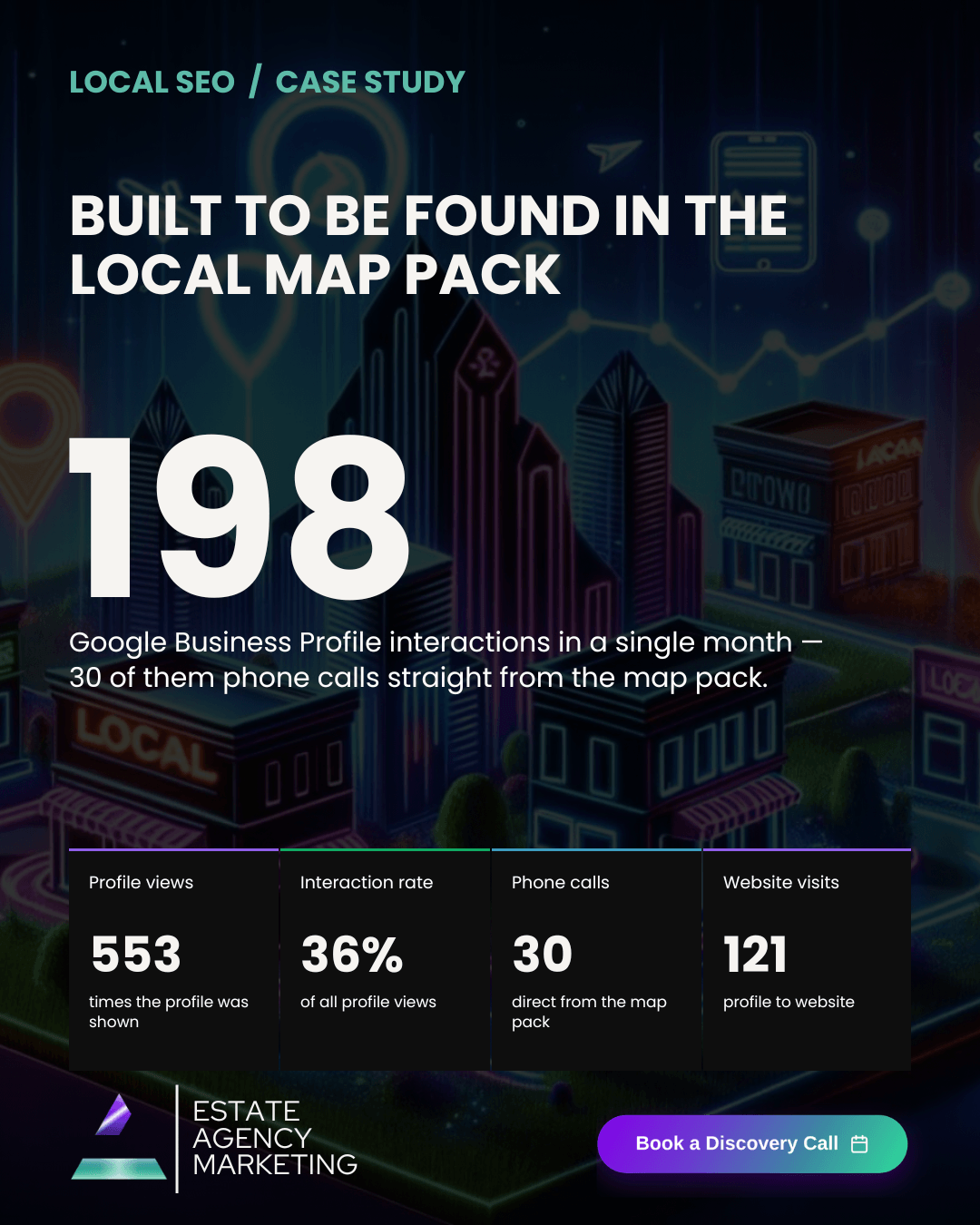
553 profile views. 198 interactions. 30 phone calls straight from the map pack.
An estate agent’s best month is rarely the month they spend the most. It’s the month they become the obvious answer to a question people were already asking.
That question is some version of “estate agents near me.” People ask it thousands of times a month in every town in Britain, and Google answers with three business listings on a map. Not ten pages of results. Three.
This is a case study about getting into those three, and about what actually happens when you do.
The Situation.
An independent estate agent with a strong local reputation offline and effectively no presence in local search.
The reputation was real: people who had sold with her recommended her. But that recommendation had to travel by word of mouth, because when someone typed her patch and “estate agent” into Google, she wasn’t in the map pack. The three listings that appeared belonged to competitors – including some she comfortably outperformed on service.
Her website existed. It just wasn’t built to be found. A handful of pages, no clear signal about what she did, and nothing at all about where she did it. Google had no reason to associate her with any particular place.
What We Did.
Local SEO for estate agents is not a trick. It’s two assets – a website and a Google Business Profile – built to agree with each other so completely that Google has no doubt about who this agent is, what she sells, and where she sells it.
1. I built the foundational pages.
Most agents’ websites have one page that tries to cover everything. That page ranks for nothing, because it isn’t about anything specific.
I built a page for each thing she actually does – selling, valuations, lettings – and separate pages for each area she covers. One page, one job. A page built around one town and the phrase people in it actually type can rank in a way a general homepage never will.
2. I built the area guides.
An area guide is not a service page with a place name swapped in. It’s a genuinely useful page about living somewhere: the streets, the schools, the commute, what property costs and what it’s actually like.
They earn their rankings honestly, because they’re the page a person moving to the area actually wants. And they give Google a substantial, specific reason to connect this agent with this place.
3. I built a supporting blog.
Foundational pages establish what she does. A blog proves she’s active and knowledgeable while she does it – local market commentary, seller advice, the things a working agent knows and most never write down.
4. I optimised her Google Business Profile.
The profile is what actually appears in the map pack: categories, services, description, photos, posts, hours, reviews. Most agents fill in a name and address and stop. I optimised all of it, because every field is a signal, and the profile with more complete signals wins.
5. I made the two work together.
This is the part that gets skipped, and it’s the part that matters. The profile links to the right pages, not just the homepage. The website’s location and service language matches the profile’s. Name, address and phone number are identical everywhere.
When the profile and the site tell one consistent story, they compound. When they contradict each other, they cancel out.
The Results.
In July, the profile was shown 553 times and produced 198 interactions — 121 clicks through to the website, 47 direction requests and messages, and 30 phone calls.
The number I’d point at isn’t 553. It’s 36%.
More than a third of the times this profile was shown, someone did something about it. That is what a high-intent channel looks like. Nobody idly searches for an estate agent — they search because they are thinking about moving, and the ones who click are the ones closest to acting.
And 30 of those interactions were phone calls. Not form fills to be chased. Thirty calls, in one month, from a channel that costs nothing per click.
Why This Matters More Than it Looks.
Thirty calls a month is a pipeline. Run your own numbers on it: if a fifth of those calls became a valuation and a third of valuations became an instruction, local search alone would be producing a listing or two a month. Your conversion rates will differ – but that is the arithmetic this channel puts in front of you, every month, at no cost per click.
It doesn’t stop when the budget does. Paid advertising is a tap. Local search visibility is an asset. The foundational pages, the area guides and the optimised profile keep working next month whether or not anything else happens.
It compounds. Every enquiry that becomes a happy client becomes a review. Every review strengthens the profile. Every strengthened profile ranks better and produces more enquiries. Paid channels don’t do that.
The Takeaway For Agents.
Being good at your job is not the same as being findable. In every town there is an agent who deserves the instruction and an agent who gets it, and often the only difference is which one appears in three listings on a map.
That gap is closeable, and it’s closeable with work rather than budget.
If you’re not in the map pack for your own town, you’re invisible to the people most ready to move. See how our Local SEO services work.
The method behind this result is set out in our SEO for Estate Agents guide. If you want the same approach in your town, book a free discovery call.